
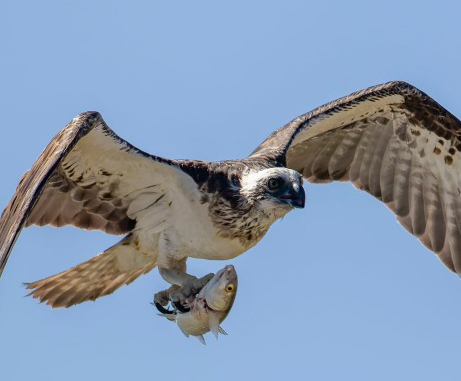
Photography: Dave Weatherall
2025/26 Annual Review
Annual General Meeting
“We defend what we love. We love what we particularly know.”
— Susan Holliday
Photography: Dave Weatherall
Who we are
- 4+ years of operation – Growing from strength to strength since our founding
- 21 nest platforms – Across South Australia’s coastline and offshore islands
- 150 members – And growing — supporters from across Australia and around the world
- Global reach – Donations received from supporters around the world and partnership with the Roy Dennis Wildlife Foundation
One of the largest Friends of Parks groups in South Australia: making measurable progress toward Osprey recovery.
Nest platforms and population data
21 artificial nest platforms across South Australia
Yorke Peninsula · Eyre Peninsula · Kangaroo Island · Adelaide region
Photography: Dave Weatherall
Preliminary census results
Survey period: 2021–2024 (Dept for Environment & Water)
- 2008–2010: 58 territories
- 2015–2017: 43 territories
- 2021–2024: 50 territories
Artificial nest platforms are a significant contributor to the increase in occupied territories, particularly on the Yorke Peninsula where the work of Friends of Osprey has seen the species re-established on the mainland.
Breeding season 2025
Nest monitoring program
Trialled for the first time in 2025, modelled on South Australia’s successful Hooded Plover monitoring program.
Volunteers are trained to visit sites from safe distances and report on nest activity.
Data is uploaded to the Biodiversity Database of South Australia, identifying successes and threats and informing critical decision-making for future Osprey management.
Active nests with chicks in 2025
- Price
- Point Davenport
- Gleesons Landing
- Cummings Monument
- Thistle Island
- Whalers Way
- Streaky Bay
- Kangaroo Island (multiple)
Photography: Dave Weatherall
Challenges this season
- Numbers below last year’s result overall.
- Toxic algal bloom may have had a negative impact on Osprey’s ability to source food in near shore environments around the state.
- Ravens identified as a significant threat at nests; birds requiring more fishing attempts than expected.
- Port Lincoln Barge: female stopped incubating, eggs removed and tested (non-viable foetus). New Point Pearce platform failed possibly due to beach vehicle disturbance.
Nest monitoring program
For the first time in 2025, Friends of Osprey undertook a comprehensive nest monitoring program across South Australia, a milestone in citizen science conservation.
Population health
Track breeding success, identify trends and detect early signs of decline.
Threat identification
Document disturbance, predation, human interference and environmental risks.
Conservation planning
Prioritise protection of active nests and guide habitat enhancement works.
Long-term research
Build a dataset on behaviour, habitat preference and climate change responses.
Community engagement
A powerful citizen science program raising awareness of Ospreys and coastal ecosystems.
Monitoring commenced June 2025 and ran through to January 2026, covering the full breeding season.
Nest monitoring — 2025/26 season results
- 34 volunteers
- 230 volunteer hours
- 150 nest checks
- 34 incidental sightings
- 40 of 70 known nest locations checked
Breeding success
16 chicks fledged from 9 nests
- Cheetima Beach
- Deep Gully
- Gleesons Landing
- Point Davenport
- Point Tin Line (KI)
- Price
- Streaky Bay
- Thistle Island
- Whalers Way
Threats identified
- Human disturbance: boating, fishing and coastal access near nesting sites.
- Habitat modification: coastal development making some sites unsuitable.
- Weather events: strong winds and storms impacting nest stability.
- Fishing line entanglement: ongoing risk for adults and fledglings.
- Food availability: algal bloom concerns affecting near-shore foraging on Yorke Peninsula and Gulf St Vincent.
Monitoring coordinated by Fran Solly, Vice President — Friends of Osprey
Citizen science: Osprey sighting reports
Alongside our formal nest monitoring program, Friends of Osprey collects incidental Osprey sighting reports from members and the public year-round — building a detailed picture of how birds are distributed across South Australia.
How to report
- Sightings can be submitted via friendsofosprey.com.au/report-sighting-of-osprey at any time of year.
- Reports are collated by the Friends of Osprey committee and reviewed for banded bird information.
- Members are encouraged to note date, location, behaviour and any visible leg band colours.
What sightings tell us
- Incidental sightings complement nest monitoring by tracking where birds forage, roost and travel outside the breeding season.
- Reports from across SA help us map the distribution and movement of the broader Osprey population.
- This season, 34 incidental sightings were recorded, ranging from the River Murray to Ceduna.
Banded bird reporting
- When a banded bird is sighted, colour band details are formally reported to the Australian Bird and Bat Banding Scheme (ABBBS).
- The ABBBS collects banding data nationally, contributing to long-term research on bird movement and survival.
- This season, 11 banded bird sightings were formally reported to the ABBBS.
Report your Osprey sightings at friendsofosprey.com.au/report-sighting-of-osprey
Satellite tracking and banding
22 birds fitted with satellite trackers to date. A large number of trackers unfortunately failed due to human error. This has been disappointing but we must learn from it and move forward.
Ervie – Boston Bay, Port Lincoln, tends to night roost at Port Lincoln wharf
Giliath – Night roosts on the wharf alongside Ervie; tracks closely follow Ervie’s
Will – Wide-ranging: Port Broughton to Port Germain, Port Pirie and Cowell
Vincent – Settled in Port Davis / Port Pirie channels area
Colour banding continues to track movements: Phantom (KI), Libby (Point Turton), Bradley (Tod River), Calypso (resident at Tulka platform since 2024). Band details on the Friends of Osprey Facebook page.
Partnership: Roy Dennis Wildlife Foundation
About the Foundation
- Established in Scotland in 1995 by Roy Dennis OBE.
- Pioneered satellite tracking of Ospreys since 1999 and coordinates the UK’s Osprey colour-ringing scheme.
- Led Osprey recovery across the UK, Spain, Switzerland, Italy and Portugal.
- A globally recognised authority on raptor reintroduction and species recovery.
Our partnership
- Knowledge sharing on nest platform design, banding, satellite tracking and fostering techniques.
- Roy’s SA visit included presentations in Adelaide, Coobowie and Port Lincoln.
- Over $5,000 raised for Friends of Osprey from Roy’s dinner sessions.
- SA tracking data contributes to global Osprey recovery knowledge.
Looking ahead
We are hoping to welcome Roy Dennis back to South Australia for a visit in late 2026. This will be an exciting opportunity to showcase the continued growth of our Osprey population and deepen our collaboration with one of the world’s foremost Osprey conservation experts.
Habitat conservation
Greyhound Road, Port Lincoln
- Three interconnected ponds providing vital Osprey foraging habitat on the outskirts of Port Lincoln.
- Friends of Osprey wrote to the City of Port Lincoln proposing a conservation and improvement strategy.
- Positive meetings held with Southern Eyre Birds, Birds SA, Eyre Peninsula Landscape Board and the City of Port Lincoln.
- Habitat protection is a hopeful prospect for this important site.
Port Lincoln desalination plant
- SA Government construction of the Billy Lights Point desalination plant passes through a key Osprey foraging corridor.
- Friends of Osprey engaged with SA Water to negotiate bird-friendly measures during construction.
- Two temporary perch poles to be erected at either end of the works.
- All new power poles through the area to be fitted with animal guards to prevent electrocution of Osprey and White-bellied Sea-eagle.
Community education and engagement
“Life of an Osprey”
The movie
- Produced by committee members Kylie Correll and Max Barr with the Edithburgh Museum, with the support of photography by Friends of Osprey member Dave Weatherall.
- Funded via the Northern & Yorke Landscape Board’s Bite-size Grants program.
- Filmed at sites around the Yorke Peninsula by local videographer Lauren Clift.
- Narrated by Elouise Fehring and packed with the latest facts, data and stunning visuals.
- An excellent educational tool for community and school audiences.
Community presentations
We are keen to engage the communities that are home to Osprey.
- Committee members available to present to local communities across SA.
- Presentations cover our latest monitoring results, nest platform program and conservation work.
- Contact us at friendsofosprey@gmail.com to arrange a presentation in your community.
Sighting reports help us build critical data. Report your Osprey sightings at friendsofosprey.com.au/report-sighting-of-osprey
Committee news
New committee members
Ainsley Parker — Treasurer
Qualified accountant with many years of experience. We are in great hands with Ainsley managing our finances.
Sonya Coleman and Greg Limbert — Far West Coast region
Sonya and Greg are based on the Eyre Peninsula’s Far West Coast and will be looking after our Osprey monitoring and conservation work in that region.
KI: Working to attract a Kangaroo Island-based committee member to improve coverage of this important Osprey region.
Website updated in 2025 — visit friendsofosprey.com.au
Thank you
To our volunteers, donors, partners and supporters — thank you for your continued commitment to the Osprey.
“We defend what we love. We love what we particularly know. We particularly know through seeing deeply.”
— Susan Holliday
friendsofosprey.com.au | friendsofosprey@gmail.com
Photography: Dave Weatherall